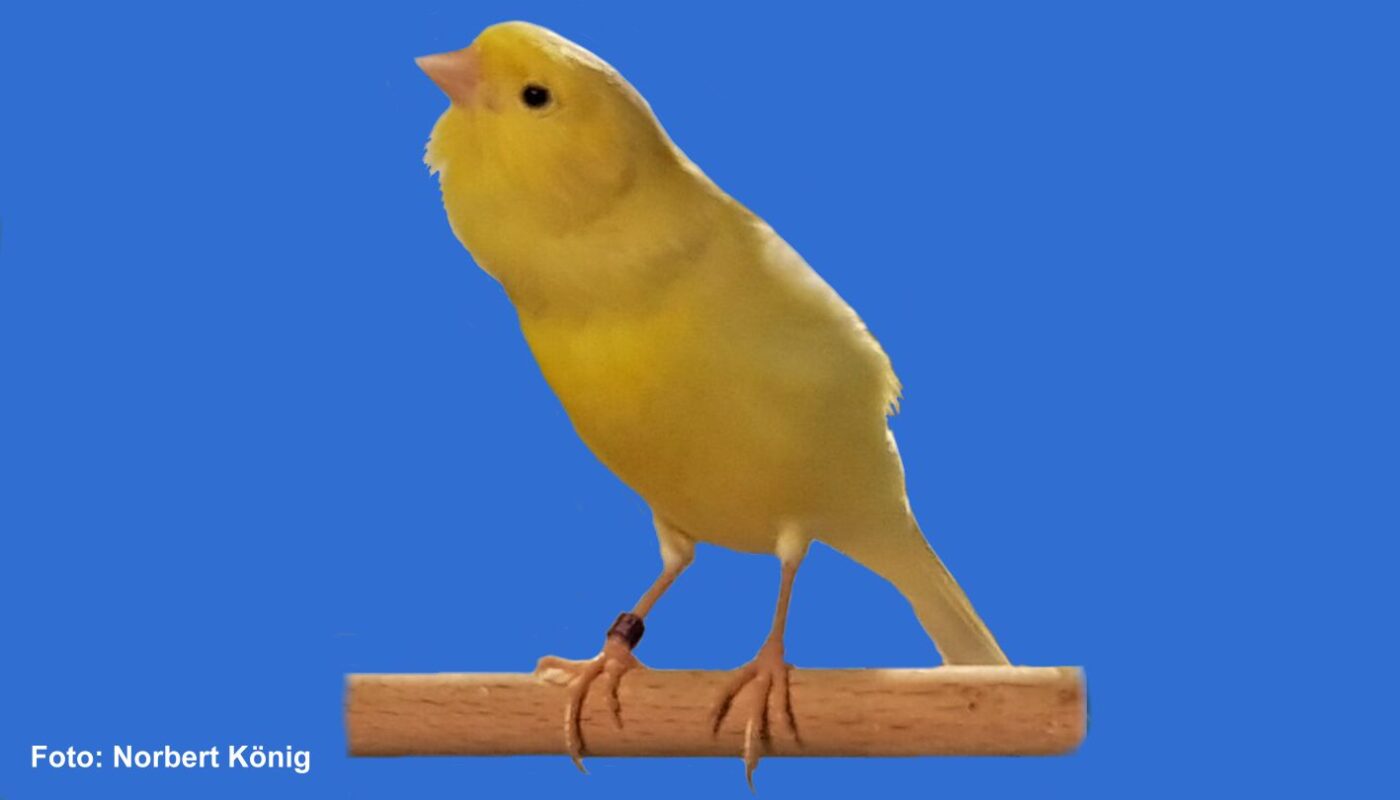

Once upon a time …
… in the small mining settlement of Sankt Andreasberg in the Upper Harz lived the miner Heinrich Friedrich Trute, known as WILHELM TRUTE (born 5 March 1836, died 20 October 1889). He bred canaries that became world-famous as ‘Harzer Rollers’. These canaries from the ‘Trutschen Stamm’ line were distinguished by their particularly fine hollow and ringing song. His canaries brought him and his hometown worldwide fame.
Many other residents of St. Andreasberg also bred song canaries, hoping to build on Wilhelm Trute’s successes and reap the rewards. Those known by name include the miner Müller, the master shoemaker Bock, the mine smith Engelke, the master tailor Mohrig, Heinrich and Eduard Volkmann, August Weyland, Wilhelm Engelke, Christian Mohrig, Ludwig Schell, Eduard Rosenbusch and the retired miner HEINRICH SEIFERT.
In October 1880, the canary breeder Otto Brandner travelled from Stettin in Pomerania to St. Andreasberg. There, he visited all the song canary breeders mentioned above and ranked their birds according to the songs they performed. The birds belonging to Heinrich Seifert, Schützen Street 96,[10] only came 12th, ‘… as the birds were still too far behind in their training at the time of the reporter’s visits.’ [1] It is also reported that Seifert worked as a professional ‘Ausstecker’. ‘Ausstecker’ were responsible for sorting the young canaries offered for sale, checking the sex, colour and overall value of the bird.[1], [9] Carl Ritsert also reported that the ‘Ausstecker’ H. Seifert acted in 1877 ‘… as a singing judge for canaries at the exhibition of the “Aegintha …” society in Berlin.’[8]
Anyone reading these old documents might assume that this H. Seifert from St. Andreasberg is one of the ‘Seifert brothers’. Far from it! It must instead be a case of a namesake or another family member.
The Seifert Brothers
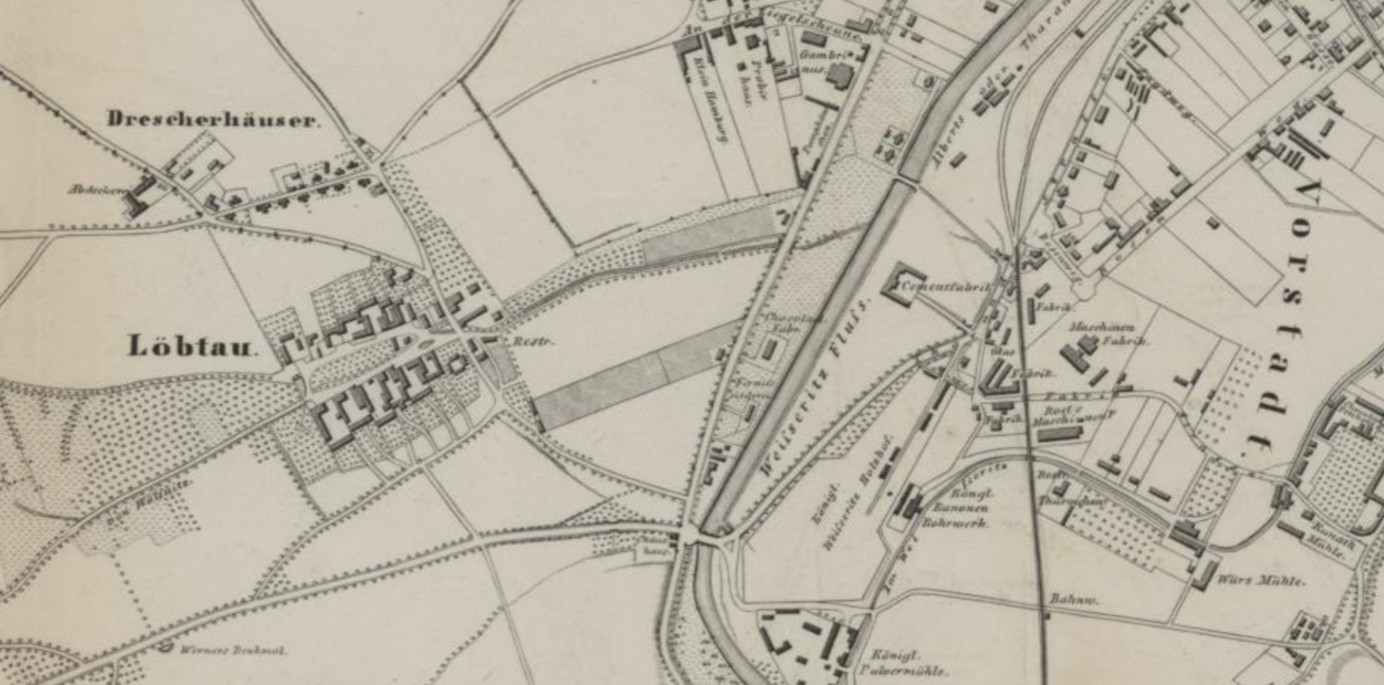
Löbtau near Dresden was a small village on the outskirts of Dresden. Because of the widespread cattle breeding, Löbtau used to be mockingly called ‘Kuh-Löbte’ (Cow-Löbte). The village green, which stretched between Tharandter Street and Zwickauer Street, served as pastureland. Whilst the village had only 163 inhabitants in 1834, the population multiplied in the following decades, and it was incorporated into the city of Dresden in 1903.
HEINRICH MORITZ SEIFERT was born in the village of Löbtau in 1862.[5] Nothing is known about his parents. However, if one consults the 1863 address book, one finds a ‘gatekeeper at the asylum for the infirm people’ named Georg Seifert, who lived on the ground floor at 5 Löbtauer Street. It cannot be determined whether this is the father of Clemens and Heinrich Seifert, but he is the only Seifert listed in Löbtau at that time.[11]
On 28 September 1880, the “1st Dresden Canary Breeders’ Association” was founded in the city of Dresden, with Mr Hromada as its chairman. As early as 1881, the first exhibition was held in the halls of the Stadt-Waldschlösschen. Later, the annual exhibitions took place in the rooms of ‘Laube’s Halls on the Altmarkt’. In 1884, another canary association – ‘Canaria I’ – was founded in Dresden.
In Leipzig, the Association of German Canary Breeders (V.D.K.) was founded in 1890 as an amalgamation of several bird protection and bird breeding associations within the German Empire.
Clemens Seifert
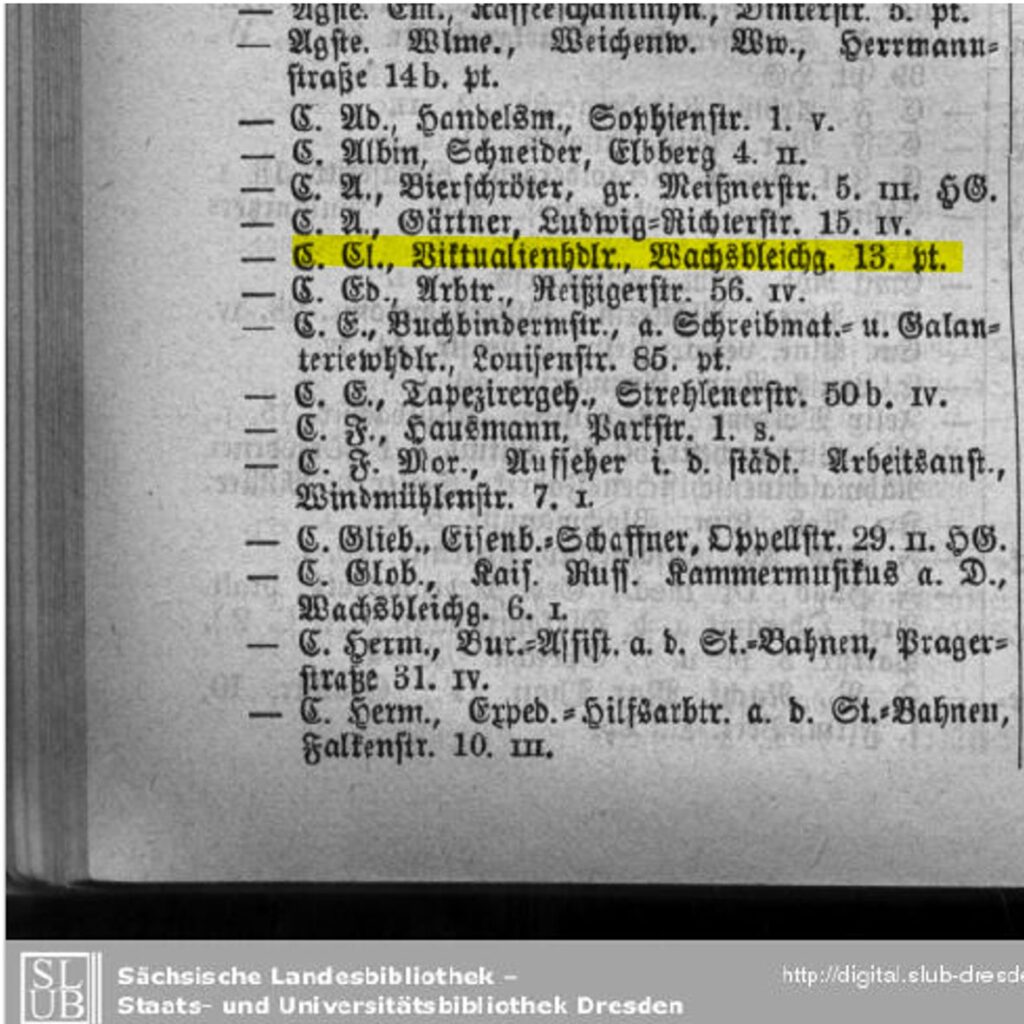
In 1885, Heinrich Seifert left his parents’ home and moved to Dresden to live with his older brother, CARL CLEMENS SEIFERT.[6]. Clemens was a grocer and lived on the ground floor at 13 Wachsbleichgasse.[12] Wachsbleichgasse (now Wachsbleichstreet) takes its name from the candle makers based there, who produced bleached white candles from yellow beeswax.
Clemens Seifert bred a stock of singing canaries which, even 14 years after his death, judges still spoke of in the highest terms. Birds from this ‘Seifert stock’ were the first true noble rollers.
From 1892 to 1898, the judge R. Fleischer from Torgau judged Clemens’s birds (he died in 1894) and Heinrich Seifert’s birds every year. In his opinion, Clemens was far superior to his brother as a connoisseur of song.
In 1893, Clemens Seifert exhibited six birds, which were awarded prizes by R. Fleischer and his colleague Laube from Chemnitz. Number 28 produced “… very curved hollow rolls and shockel down to the lowest pitch, then a Dau whistle; the hollow ringing and ring were also very beautiful. The other birds performed almost exactly the same in the hollow rolls, ringing and low pipes. Only No. 31 produced the Hie pipes very frequently.“[14]
Enthused by the birds, both judges wished to purchase birds from Clemens Seifert. However, he was unable to part with the ones they wanted but mentioned that he had bought some males from the bird dealer Clauß in Dresden, and that the deep-voiced birds were among the young ones.
In mid-September 1894, Fleischer travelled back to Dresden to visit Clemens Seifert to buy birds. “He had the oldest males in individual cages; two older birds were still singing, one of which excelled in its hollow rolls and deep pipes, though its high notes were a little sharp.“[13] But Clemens did not sell any birds on this occasion either, as he did not have long to live and wished to enjoy the birds for a while longer. His premonition proved correct, for he died in October 1894.
Clemens Seifert was probably a member of the ‘1st Dresden Canary Breeders’ Association’, which still exists today, as the second Dresden breeders’ association, ‘Canaria I’, was not founded until 1884.[6] Unfortunately, it is not known whether Heinrich Seifert was a member of any breeders’ association, or if so, which one. However, the two brothers attended the association’s exhibitions together. „There, Heinrich listened to the noble rollers and decided he too wanted to breed such birds, but only those with exceptional singing abilities. Clemens’s birds did not appeal to his brother Heinrich.“[6]
Heinrich Seifert
Heinrich Seifert began breeding the common country breed in 1889.[5], [15]
“At Clauß’s, he heard birds that were very deep voiced but also had faults. He acquired two deep-voiced cocks with the aim of reducing and eliminating the faults appearing in the offspring through selective breeding. He also received eight females from Clauß, which came from a breeder who had pure birds. With these birds, Seifert began his noble roller breeding in 1891, and he bred for only three years.“[6]
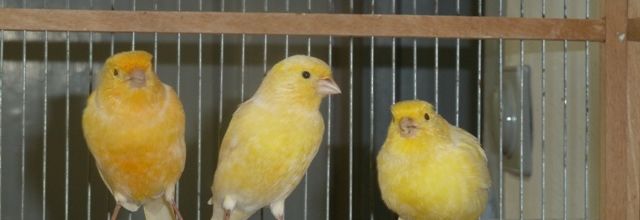
In the minutes of the V.D.K. General Assembly held on 15 and 16 August 1908 in Kiel, judge R. Fleischer from Torgau speaks under agenda item 5. His topic: ‘The Seifert birds and their development.‘[14] Mr Fleischer stated that the Seiferts kept a closely guarded secret regarding the birds they bred. The judge went on to recount events from the year 1894.
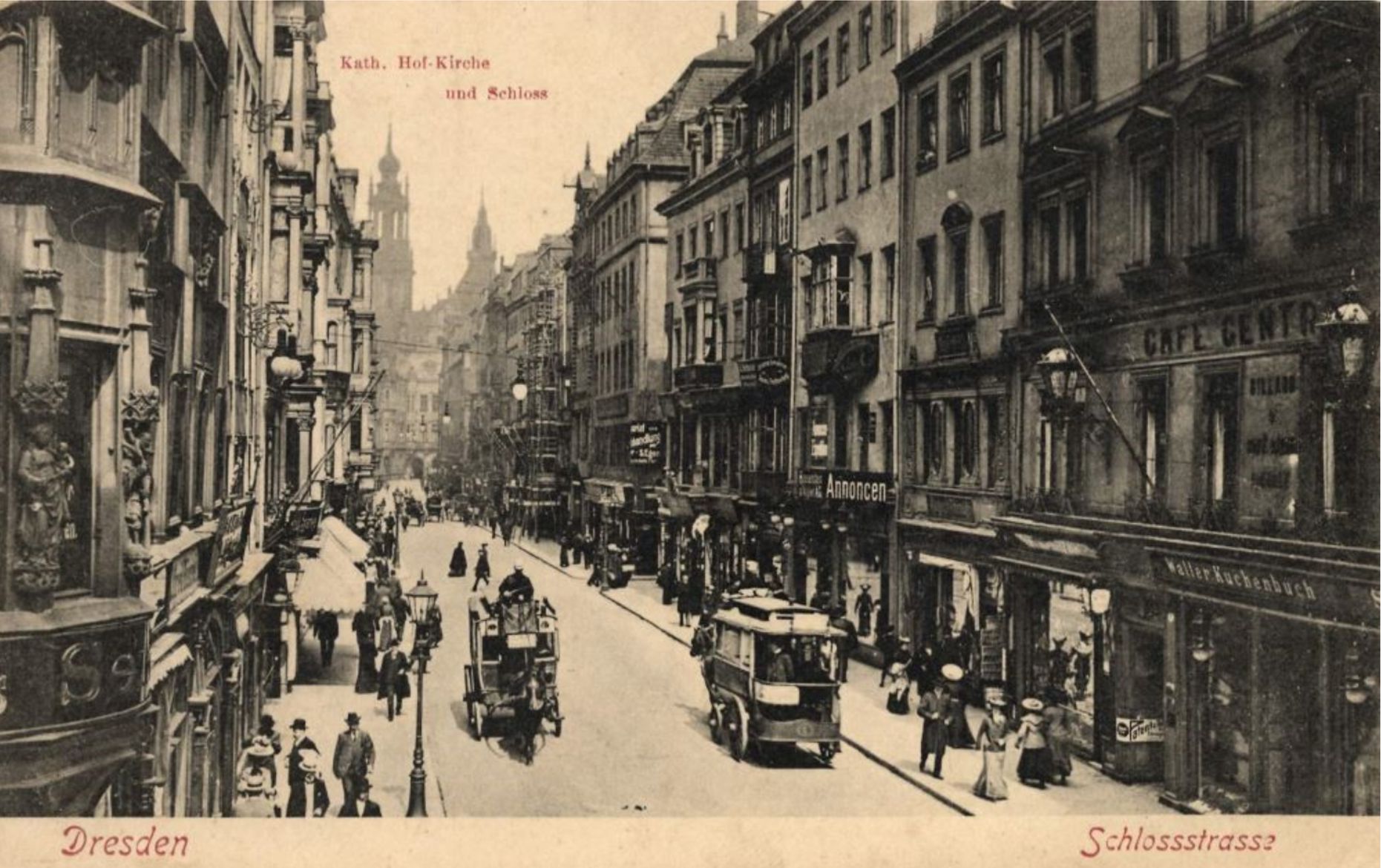
Following the death of Clemens Seifert, Heinrich took over his birds. However, he sold them on to a Mr Kanitz. There, Mr R. Fleischer wished to purchase Clemens’ birds, but discovered that they were not Clemens’ birds. Heinrich Seifert had therefore passed off his own birds as Clemens’s. He immediately went to see Heinrich Seifert, who is said to have lived in Schlossstraße in Dresden, already a very prestigious address at that time. However, not a single Seifert is listed in the address books of that period as living in Schlossstraße. It is possible that he was a subtenant, though this would have required a great deal of understanding on the part of the property owner, given his large collection of birds.
At Heinrich Seifert’s flat, Mr R. Fleischer never again heard a more beautiful song than he did on that occasion. “Deep hollow rolls and shockels, lovely ringing, and du and dau pipes alternated with one another. There was also a coller bird among them with a fine hollow roll and lovely ringing, but it very often produced a beautiful ascending melody accompanied by poor high-pitched pipes. … Hollow rolls, ringings, shockels and pipes, everything was clear; there was metal in it.“[14]
R. Fleischer also reported on Heinrich Seifert’s peculiar sales practices. For hours on end, he would present birds to song connoisseurs, claiming he wished to sell them. Naturally, the buyers then wanted to purchase the best singers. But Heinrich Seifert would then say that he could not sell them, as he needed them himself. Through this roundabout method, he gained an understanding of his birds’ singing ability. “Without this ‘help’, he would not have managed, for his knowledge of song was minimal at the time. And the fact that the birds came from his late brother was something he had to keep to himself for various reasons, for he also wanted the recognition his brother had enjoyed, so he had to keep quiet.“ [14]
There are quite differing accounts of the subsequent development of the ‘Seifert birds’. For instance, the six birds he exhibited on 1 January 1895 are said to have produced only a muffled version of the earlier clear hollow, and the beautiful clear ringing no longer had that lovely metallic quality.[14] Neibecker, on the other hand, writes that these were the first pure birds to cause a sensation due to their particular depth.[6]
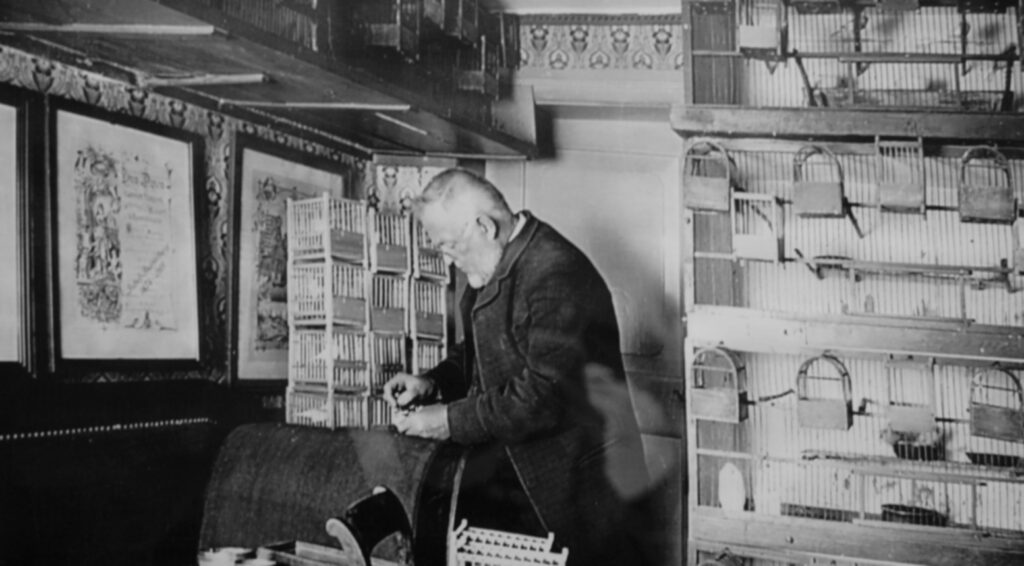
R. Fleischer also states that the birds had not developed further in the following year, 1896.[14] However, other sources indicate that his collection (then comprising six birds) was awarded 378 points in Dresden in 1896, the highest score achieved up to that point.[6],[15] Heinrich Seifert later commented: “Had I been a member of the V.D.K., I would have received the Gold Medal back then. The visiting breeders were astounded when they heard my birds. In particular, it was Mr Fleischer of Torgau who was delighted with the depth of my stock.“[15]]
R. Fleischer also believed that, in 1897, Heinrich Seifert had once again secured better stock, and that in later years he had succeeded in introducing the Knorre and maintaining his high level.[14] How he came to this conclusion remains a mystery, for in 1898 Heinrich Seifert scored 497 points in Leipzig with his six birds, an average of 83 points per bird.
Heinrich Seifert’s successes can also be attributed to a new breeding method. Most breeders bred their birds in a flight cage – keeping several males and females together. This meant that the parentage of the young birds could not be clearly determined, and targeted selection was not possible. Heinrich Seifert placed the females in a cage and added a specific male until the fourth egg was laid. The male was then moved to another female. In this way, a male’s valuable singing qualities could be passed on to many females and their young. The parentage could also be verified, which aided in the subsequent selection of the new breeding birds. Heinrich Seifert initially bred with eight females and one or two males. Later, the numbers rose to as many as 100 females and 30 males.[15]
Surprisingly, Heinrich Seifert emigrated to America in 1902 (‘America’ is surely a synonym for the USA). Others believe he was driven out of the German Empire on ‘flimsy’ grounds. The bird stock was divided up. Heinrich Seifert says of this: “The best birds went to [Dr] Wolf in Dresden. He selected them. [M.] Hermekin, Berlin, received the remaining stock, which he took over, but also some good birds. Other fellow breeders took only individual birds. However, my wife kept the very best birds and continued to breed with them; I took some of them with me to America.“[15]
Following the First World War and the collapse of the German Empire, Heinrich Seifert returned to Germany in 1918 (not 1920, as other sources state). He brought back 78 birds from America, which was more than he had taken with him.[15] As early as 1919, he exhibited at the Leipzig clubs ‘Kanaria’ and ‘Fortschritt’, where his collection received varying scores in the general class, ranging from 336 to 262 points.[6] The general class included birds not bred by the owner or birds without rings.
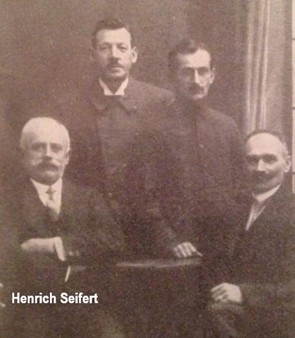
On 15 August 1920, the 26th General Assembly of the V.D.K. took place in Dresden. At 9.30 am, the chairman, Fritz Blanck from Berlin-Wilmersdorf, opened the meeting. As the conference was held in the hometown of Heinrich Seifert, “… from where the Seifert bird began its flight into the world of fanciers. Thanks to the depth of this widespread strain, breeders have been and continue to be able to further perfect the song of the German Noble Roller. Today we shall learn more about the origins of this much-discussed stock.“[15]
As many legends have arisen around the Seifert birds – such as the claim that the deep pipes were achieved with the help of crossbred female bullfinches – Heinrich Seifert was asked to recount his career and answer questions from the attending breeder delegates.
The chairman, Fritz Blank, asked:“It has been claimed that you received your first birds from your brother.” Heinrich Seifert replied: “That is incorrect. My late brother, with whom I ran a business, only began breeding later on. He initially had birds from me but later acquired a different stock. … My brother had a fine, pure ‘Klingel’ strain, for which he won six second prizes at an exhibition, but the birds lacked the deep hollow. After that exhibition, my brother said to me: ‘Now I’m going to acquire your strain, despite its many faults.’ Through selective breeding, we were then able to introduce the depth into his strain very quickly.“[15]
Why Heinrich Seifert made this statement remains a matter of speculation. According to the accounts of contemporary witnesses that have been researched, things were probably a little different. Clemens Seifert had clearly started breeding song canaries much earlier and was, in fact, very successful.
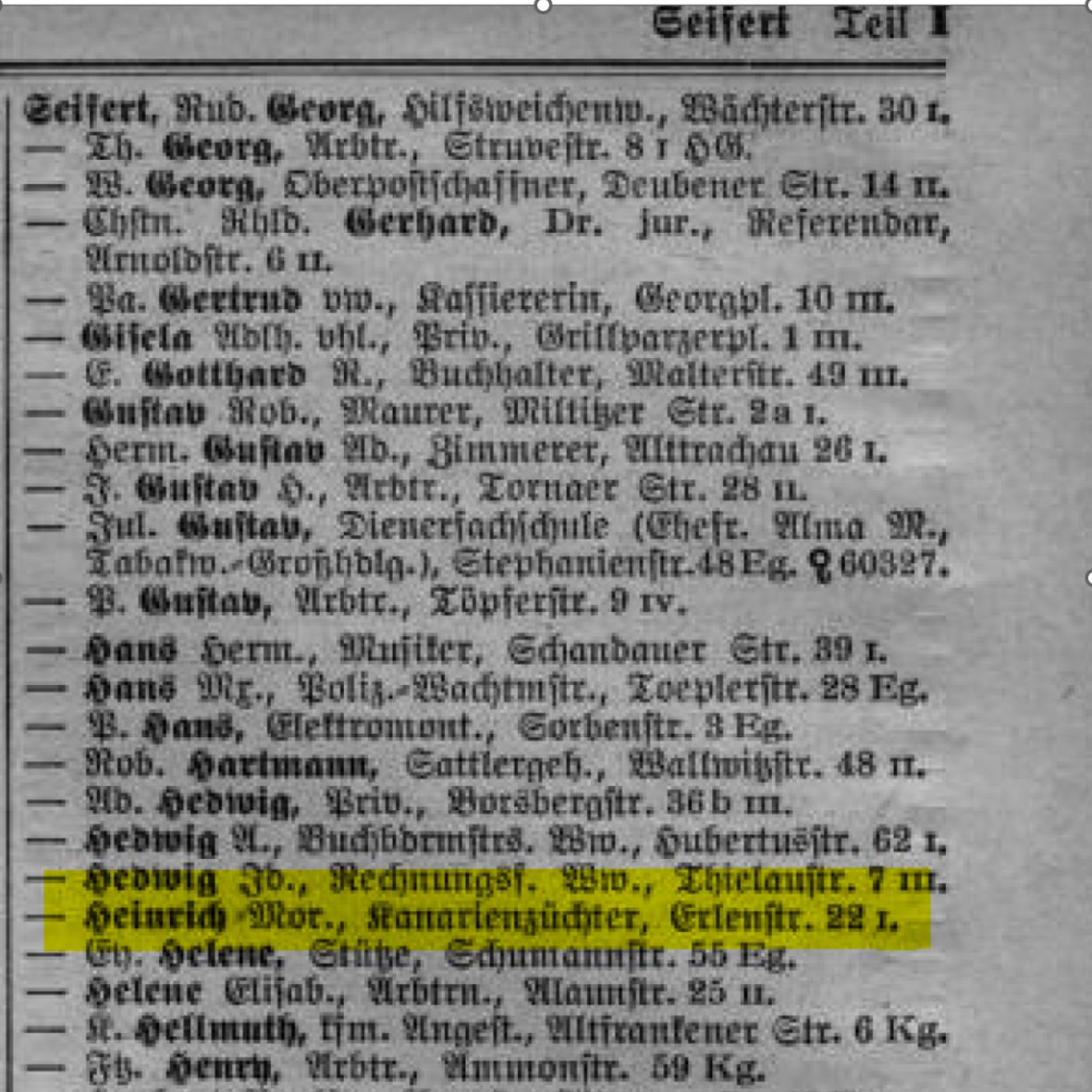
No further records of Heinrich Seifert have survived since the V.D.K. Congress in Dresden in 1920. The period that followed was marked by the Great Depression and hyperinflation. This must have placed enormous demands on many bird breeders to keep their hobby going through this time, and some will have given up. Heinrich Seifert evidently continued to breed canaries, as he had ‘canary breeder’ entered in his entry in the 1932 Dresden address book. His last known address was therefore Erlen Street 22, 1st floor, in Dresden-Neustadt.
HEINRICH MORITZ SEIFERT died in Dresden in 1932 at the age of 70.
Acknowledgements
At the suggestion of Manuel Matoses Córdoba, I set out to research the biographies of the Seifert brothers. They were canary breeders from my hometown of Dresden, and at least Clemens Seifert was presumably a member of my local club, the „Dresdner Kanarienzüchter 1880 und Exotenzüchter e.V.“
I received a great deal of support in my search for historical documents from: Jochen Klähn of the Canary Museum in St. Andreasberg, Hans Kalis of Hanke Verlag, and my breeder friend and song canary breeder Michael Woithe. Many thanks to them all.
Norbert Schramm
March 2026
Sources
[1] Brandner, Otto: Der Harzer Kanarienvogel. Stettin 1881.
[2] Drott, Gottfried: Die Seifert-Vögel – In: Der Kanarienfreund 11/1996
[3] Gorges, G.: Zur Geschichte der Seifert-Vögel – Kanaria 1908
[4] Hungenberg, Olaf: Zur Geschichte der „Seifert-Vögel“. Der Kanarienfreund 20/1989.
[5] Matoses Córdoba, Manuel: Heinrich Seifert: La Primera Revolutión del Harzer. El Canario Roller 36/2025
[6] Neibecker, Hans: Der Edelroller und seine geschichtliche Existenz. Saarlouis. Aufsatz im Besitz des Harzer-Roller-Museums St. Andreasberg.
[7] Pütz, Paul: Stamm Trute und Seifert. Der Kanarienfreund 14/1989.
[8] Ritsert, Carl: Der Harzer Canarienvogel. Selbstverlag, Heilbronn 1878.
[9] Ruß, Karl: Der Kanarienvogel. Hannover 1880.
[10] Schneider, Bernhard: Bergmann Wilhelm Trute – Züchter des ersten „Harzer Rollers“. Gefiederte Welt 3/2002.
[11] Adress- und Geschäfts-Handbuch der königlichen Haupt- und Residenzstadt Dresden für das Jahr 1863. SLUB Dresden
[12] Wohnungs- und Geschäfts-Handbuch der königlichen Haupt- und Residenzstadt Dresden für das Jahr 1890. SLUB Dresden.
[13] Adressbuch Dresden – Vororte, Freital – 1932. SLUB Dresden
[14] Generalversammlung des V.D.K. am 15. und 16.08.1908. Veröffentlicht in „Kanaria“ 26, Oktober 1908.
[15] Generalversammlung des V.D.K. am 15. August 1920. Nachveröffentlicht im „Der Kanarienfreund“ 11/1996.